Inside the Four-Stage Modernization Pipeline
The four stages most modernization programs run, and the one they actually finish
Enterprise architects know the playbook. A modernization program kicks off, a discovery workstream stands up, three to six months disappear into dependency mapping and stakeholder interviews, and the team produces a current state document that is already out of date by the time it lands. The target state shows up in directional language. The business case gets assembled in a separate workbook by a different team using different assumptions. The implementation roadmap is built from a tooling backlog rather than from the architecture.
This is a coupling problem rather than a process problem. The four artifacts that any serious modernization program needs (current state, target state, business case, implementation roadmap) get produced as if they were independent deliverables, and they are not. Each one is a structured transformation of the one before it, and the fidelity of each output is bounded by the fidelity of the input. When the current state assessment is shallow, every downstream artifact inherits that shallowness, and no amount of consulting polish on the business case can fix it.
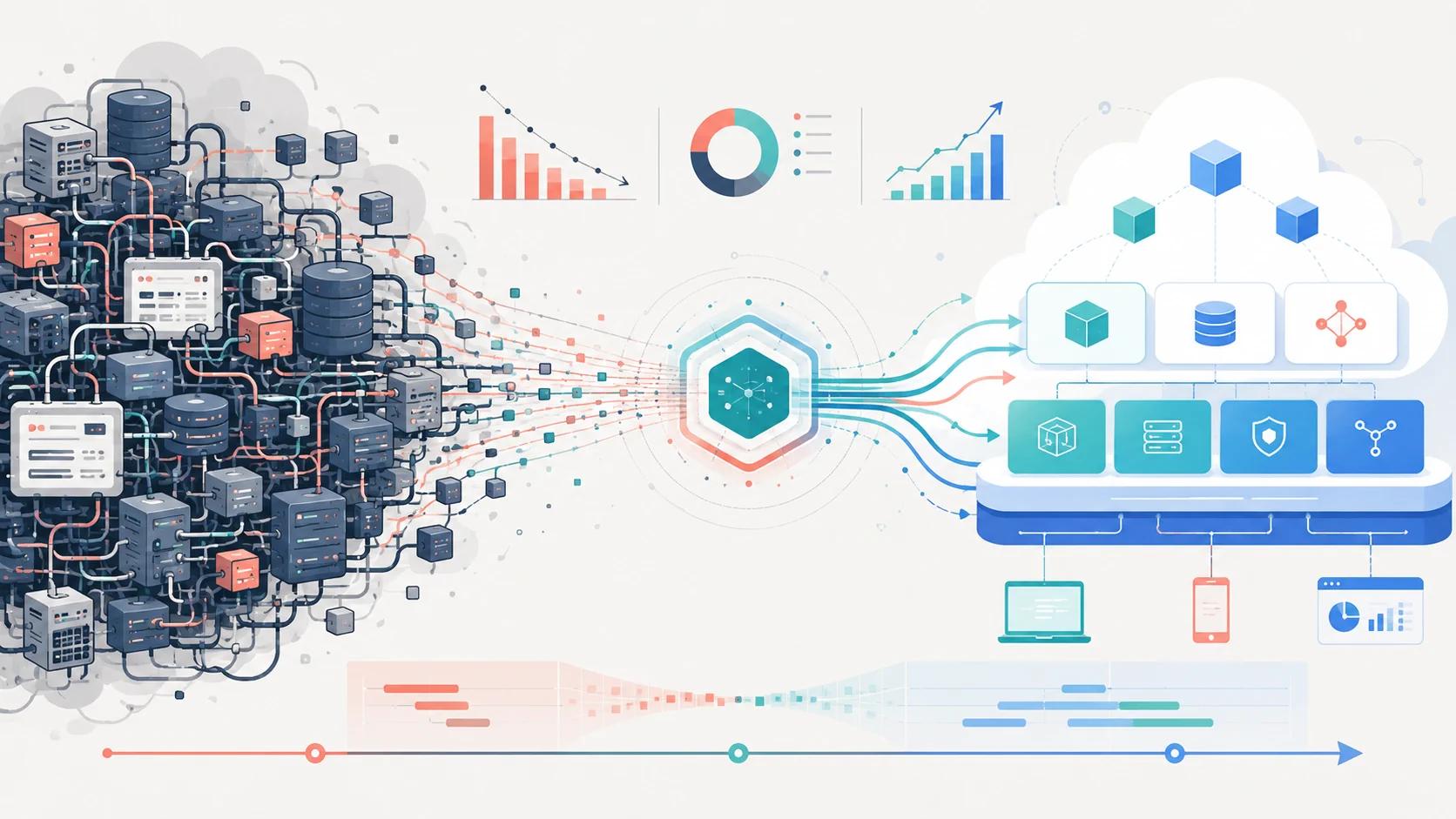
An AI accelerator does not earn its place by making any single stage faster in isolation. It earns its place by letting the same analytical substrate (the structured representation of the codebase, dependencies, and architectural patterns) flow continuously through all four stages. That continuity is what compresses a three-to-six month assessment into two to four weeks, and it is what this article is about.
Stage 1: current state assessment
The current state stage is where most modernization programs spend the majority of their budget and produce the least durable output. The reason is structural. Manual assessment scales with the number of architects on the engagement, and architects are expensive, scarce, and inconsistent in how they document what they find. Two architects analyzing the same .NET Framework monolith will produce two different dependency maps, two different complexity assessments, and two different opinions about which components are the highest-risk.
ArchWeaver replaces this stage with automated ingestion across ten programming languages including Java, C#, .NET, Python, Go, JavaScript, TypeScript, PHP, Ruby, and COBOL. The platform connects to local Git repositories (GitLab, GitHub Enterprise, Bitbucket Server), accepts code archives, ingests Terraform configurations and SBOMs, and parses client-supplied architecture documents through an AI summarization layer.
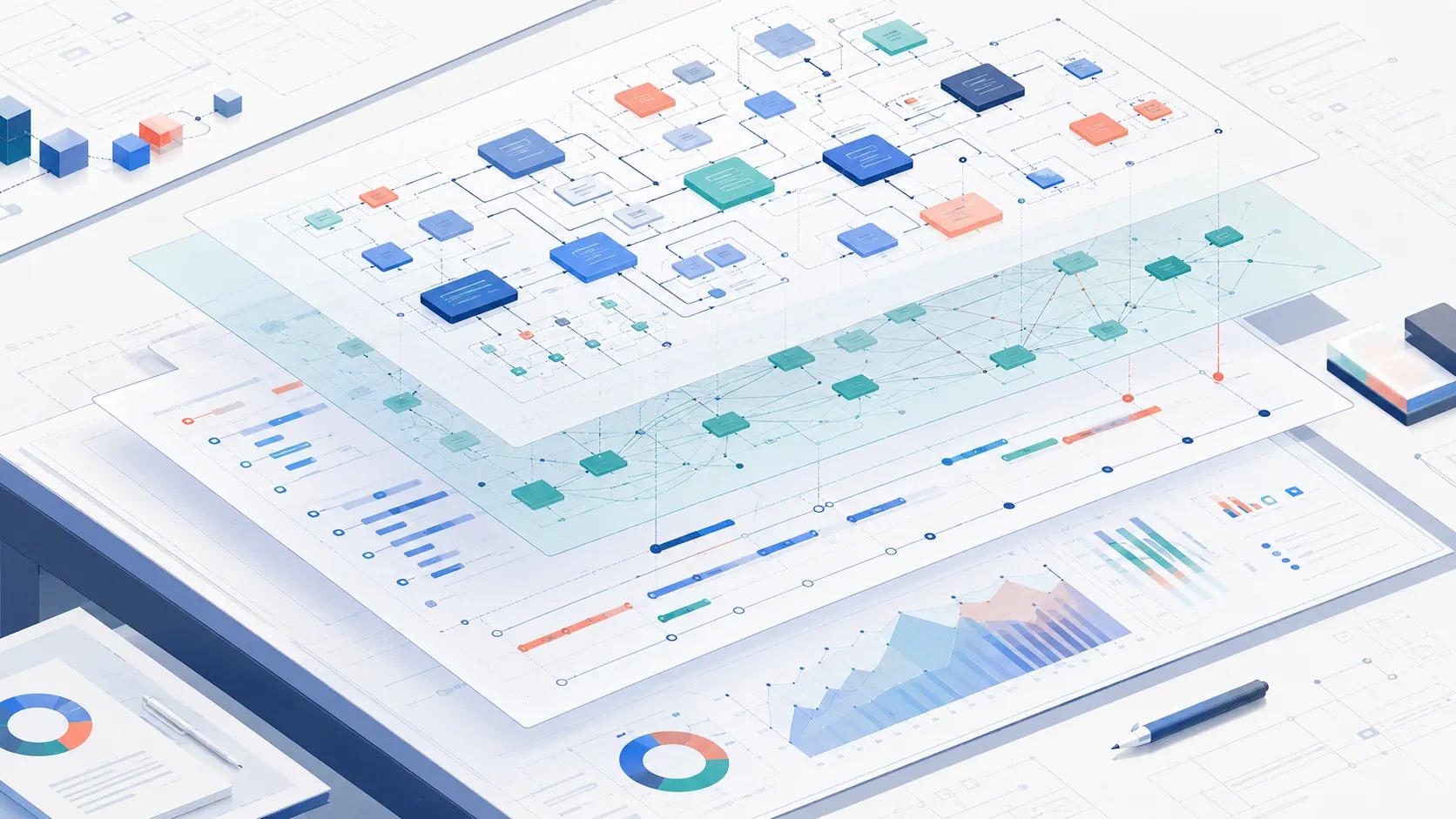
What comes out the other side is a unified graph model. Every component, every dependency, every database, every API contract, every external integration, rendered as a queryable structure. For a typical analysis run of up to a hundred applications, the platform processes more than a thousand components and renders more than five hundred nodes in interactive visualizations that load in under three seconds.
The architectural discipline this enforces is worth naming. A graph model is not a slide. You cannot wave your hands at it. Either a component depends on a database or it does not. Either an API call crosses a bounded context or it does not. The artifact that flows into stage two is a precise, machine-readable description of what the estate actually contains, and that precision is what makes the rest of the pipeline possible.
Stage 2: Target state recommendations
The target state stage is where AI earns its place in the pipeline, and also where it is most often misused. Pattern matching against a recommendations library is not target state design. Real target state work requires reasoning over the structure of the estate (the bounded contexts that already exist whether the codebase acknowledges them or not, the data ownership boundaries that the schema implies, the integration points that constrain decomposition order) and producing recommendations that are defensible at the component level, not just at the application level.
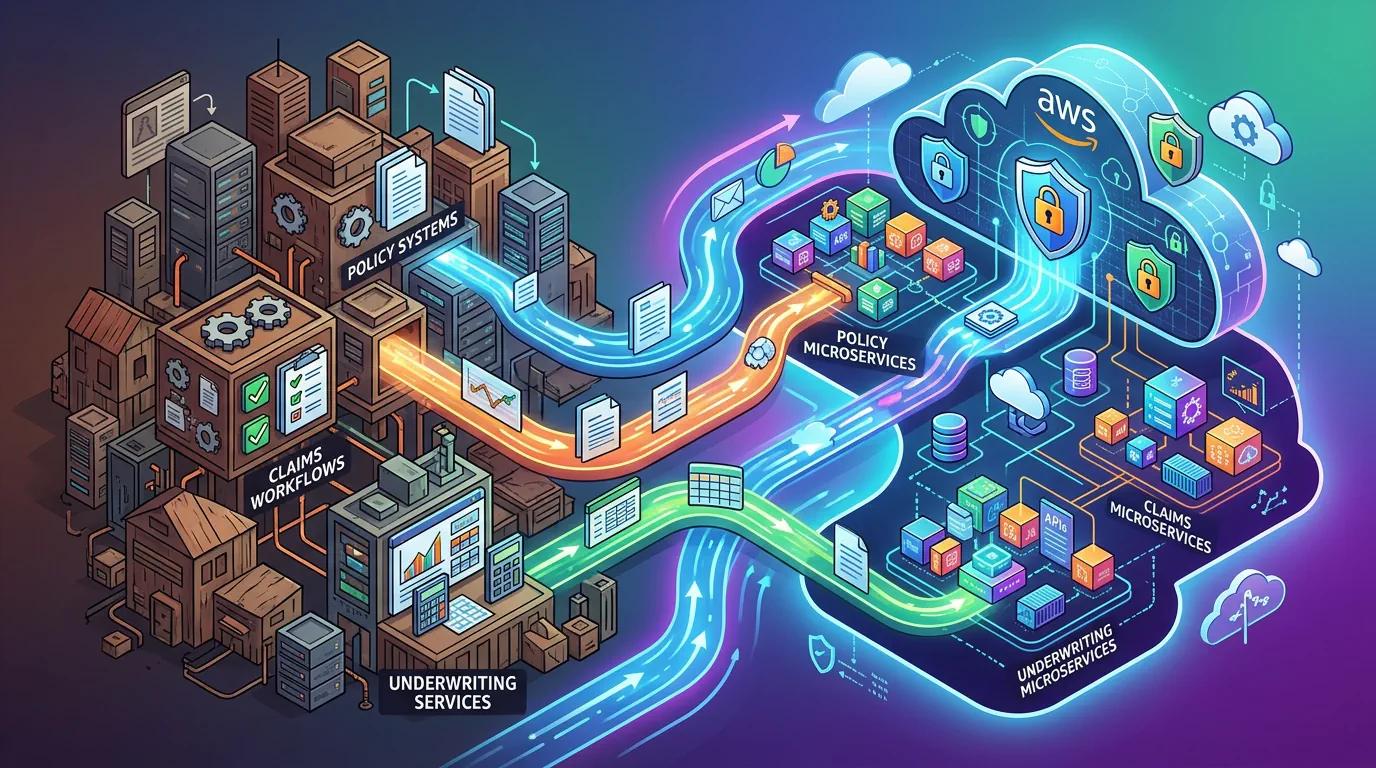
ArchWeaver evaluates each component against the 6R framework: Rehost, Replatform, Refactor, Rearchitect, Rebuild, Replace. Every recommendation carries a confidence score, a rationale, and a list of supporting evidence drawn from the graph model. Where multiple target architectures are viable (cloud-native on AWS, microservices on Azure, a hybrid containerized approach) the platform produces parallel scenarios so the architect can compare them on the same analytical basis rather than litigating each one separately.
In practice, more than seventy percent of the recommendations produced this way are deemed actionable by reviewing architects without modification. The remaining recommendations are not failures. They are the cases where domain context, regulatory constraint, or organizational reality narrows the option set in ways the platform cannot infer from code alone, and that is exactly where architect judgment belongs.
Stage 3: Business case generation
The business case is the artifact that decides whether a modernization program gets funded, and it is also the artifact that traditional approaches produce worst. The reason is that the business case is downstream of the target state, but in most engagements it is built upstream of it, on assumptions that the target state will eventually validate. By the time the actual target state is finalized, the business case numbers no longer match, and the program either re-baselines (slow) or proceeds on numbers everyone privately knows are wrong (worse).
When the business case is generated from the same graph model and target state recommendations that the architects already reviewed, the math is consistent by construction. ArchWeaver integrates with AWS, Azure, and GCP cost calculator APIs to produce current-state TCO estimates, target-state cost projections across each scenario, implementation effort estimates, ROI calculations, IRR analysis, and a five-year cost trajectory. The output is a 10 to 12 page executive decision report, exportable as PDF, generated in under two minutes.
The numbers worth flagging here are the ones that hold up across engagements. Roughly ninety percent of the reports the platform produces are used directly in leadership presentations without rework. More than eighty percent of analyses surface a positive ROI projection at the application or portfolio level, which is itself a useful diagnostic because it means the cases where ROI does not pencil are visible early rather than discovered six months into delivery.
Stage 4: Implementation roadmap
A roadmap is not a Gantt chart. A roadmap is a dependency-aware sequencing of decisions, where each phase has been chosen because the work in it unblocks the work in the phase after it. Most legacy modernization roadmaps fail this test. They are built from team capacity rather than from dependency structure, which is why the third quarter of every modernization program is the one where everything stalls waiting for a database decomposition that should have happened in the first quarter.
The roadmap stage takes the graph model, the target state recommendations, and the business case as inputs, and produces a phased plan with risk-based prioritization, resource estimates, and exportable artifacts in MS Project and CSV format. Because the dependencies are derived from the graph rather than from interviews, the sequencing is auditable. An architect can ask why component X is in phase two and the platform can answer by pointing at the specific upstream dependency that blocks earlier scheduling.
For an estate of up to a hundred applications, the full pipeline (ingestion to roadmap) runs in roughly thirty minutes of compute time. The architect time required to review and refine the output is measured in days rather than months.
Why the pipeline matters more than any single stage
The temptation, when reading a piece like this, is to evaluate the platform stage by stage and compare each one to the best point tool in that category. There are excellent point tools for static code analysis. There are excellent cost calculators. There are excellent project planning tools. None of them produce the artifact that an enterprise architect actually needs, which is a coherent program plan whose four core deliverables are derived from the same analytical foundation and remain consistent with each other as the estate evolves.
That coherence is the architectural contribution. It is also why the assessment compression number that ArchWeaver reports (40 to 60 percent faster, two to four weeks instead of three to six months) is a downstream effect rather than the goal. The goal is consistency across artifacts. The speed is what consistency enables.
What this means for how you scope your next modernization program
If you are an enterprise architect scoping a modernization program in 2026, the framing question is no longer whether to use an AI accelerator. It is which stages of your pipeline currently produce artifacts that other stages can actually consume, and which stages are producing slide decks that get rebuilt downstream. Wherever the answer is the second one, that is where the pipeline is broken, and that is where the analytical substrate matters more than the headcount you put against it.
The four-stage pipeline is not new. What is new is the ability to run it as a single connected workflow rather than four disconnected ones.