Project Overview
A mid-market B2B industrial distributor operating across North America runs its commercial platform on a mixed .NET and SQL Server estate that has evolved over more than a decade. The platform combines a customer-facing e-commerce front end, an internal sales and quoting application, an order management system that integrates with the distributor's ERP, and a customer service portal. The estate spans .NET Framework, .NET Core, classic ASP.NET Web Forms components, and a SQL Server data tier with a substantial volume of stored procedure logic. Total scope across the engagement was roughly thirty-five applications and several hundred database objects.
The distributor's CIO had decided to outsource the modernization program to a hyperscaler-aligned system integrator, with an explicit mandate that the program had to qualify for AWS partner funding and had to be delivered against a fixed-fee commercial model that the distributor's procurement function had committed to. The SI engagement was therefore under both technical and commercial pressure. The technical scope was wide, the commercial envelope was tight, and the timeline was constrained by the distributor's seasonal sales cycle, which meant any cutover work had to fit between two specific calendar windows.
This engagement is illustrative of the modernization pattern ArchWeaver supports for SI-led delivery: a mixed legacy stack, a fixed-fee commercial structure, hyperscaler partner funding as a precondition for program economics, and a customer environment where the SI is not in residence and cannot deploy unconstrained delivery capacity.
The Challenge
The SI's pursuit team had won the engagement on a delivery model that committed to specific outcomes inside a specific commercial envelope. The challenge set, from the SI's perspective, was as much about delivery economics as about technical scope.
Mixed estate complexity. The distributor's platform was not a single legacy stack. It combined .NET Framework Web Forms components that dated from the original platform build, .NET Core services that had been added over the last several years, a SQL Server tier that mixed traditional relational schemas with stored procedures encoding pricing logic, and a customer-facing front end that had been refreshed twice without ever being fully detached from the underlying server-side rendering model. A traditional assessment approach would have required a team mix the SI did not have allocated to the engagement.
Fixed-fee margin pressure. The SI had priced the assessment phase against a margin model that assumed traditional delivery economics. If the assessment ran long, the SI absorbed the cost. If the assessment was incomplete, the delivery phase would inherit risk that the SI would also absorb. The pursuit team's commercial commitments depended on the assessment phase finishing on time and producing an artifact that the delivery team could execute against without rework.
AWS partner funding window. The distributor's program economics depended on AWS MAP funding, which depended in turn on a credible migration plan being submitted to AWS within a specific window. A delayed assessment would push the partner funding decision out, which would push delivery start out, which would compress the delivery timeline against the distributor's seasonal cutover constraint. The dependency chain was tight enough that the assessment timeline was effectively the program's critical path.
Customer environment constraints. The distributor's IT environment was not built for an external assessment team. The codebase lived in an on-premise Bitbucket Server instance, the SQL Server tier ran in a private network segment with controlled access, and the distributor's information security policy did not permit the codebase or schema to be analyzed in the SI's own environment or in any vendor SaaS platform. The SI had to deliver the assessment inside the distributor's network, with a footprint the distributor's infrastructure team would approve.
The SI's program lead needed an assessment approach that compressed the elapsed timeline aggressively, produced an artifact set the AWS partner team would underwrite for MAP funding, kept the SI's bench utilization on a sustainable curve, and operated entirely within the distributor's network perimeter.
The Solution
ArchWeaver was deployed as containerized microservices inside the distributor's network, on infrastructure the distributor's team provisioned to the platform's published specification: 8 cores, 16 GB of RAM, 100 GB of storage. The deployment was completed within a single business day, with the distributor's information security team validating the network isolation posture against their internal review checklist. The SI's program team accessed the platform through the distributor's standard remote access infrastructure, which kept the SI consultants outside the data perimeter while still letting them drive the assessment.
The assessment ran across a two-week elapsed window.
Ingestion across the mixed stack. The platform ingested the full codebase across .NET Framework, .NET Core, the Web Forms components, the front-end TypeScript and JavaScript, and the SQL Server schema and stored procedures. The mixed-stack ingestion was the single most important early-stage outcome of the engagement, because it confirmed that the assessment did not need to be split into separate workstreams for the different parts of the estate. A single graph model spanned the entire commercial platform.
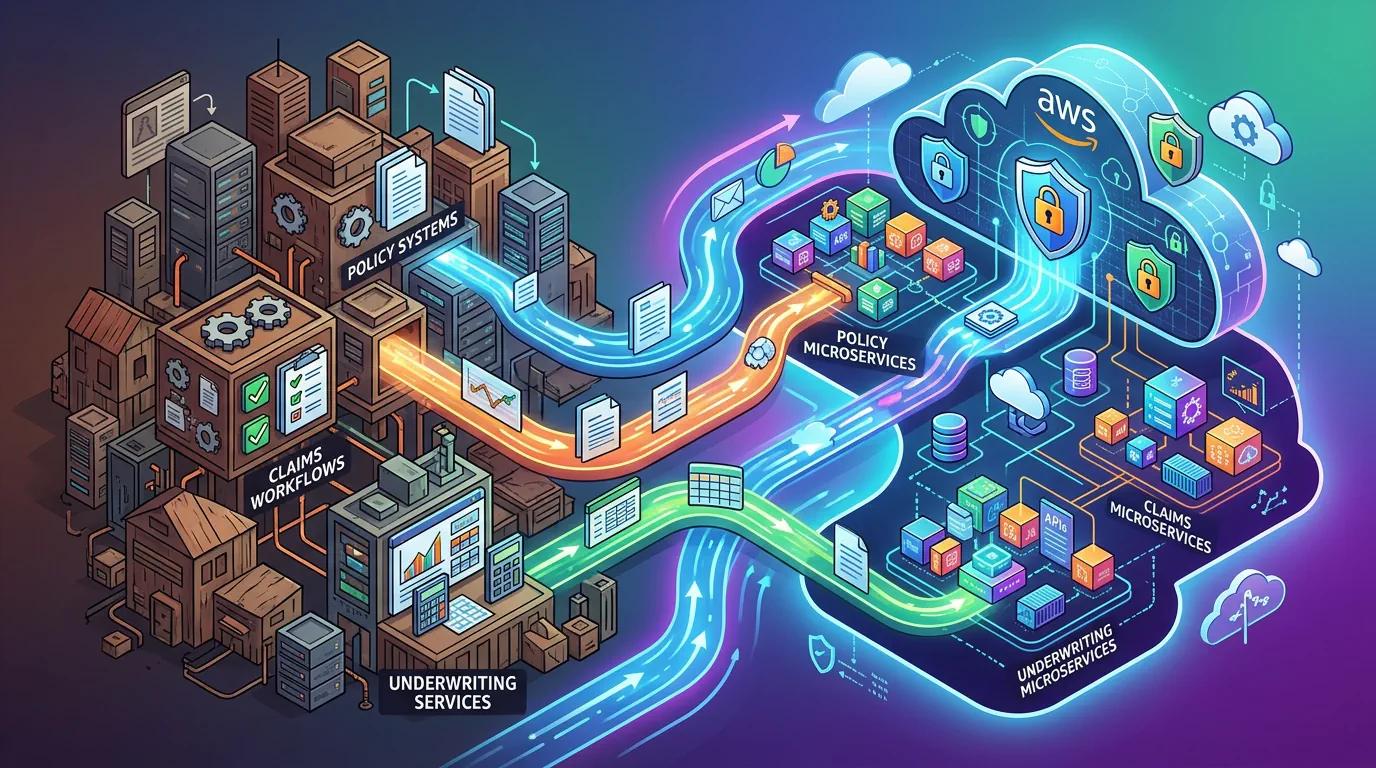
Current state model. The platform rendered an architecture model containing more than 1,100 components and a dependency graph that surfaced cross-application coupling the distributor's internal team had been aware of in the abstract but had never had a complete map of. Specifically, the model exposed the integration points between the e-commerce front end, the order management system, and the underlying ERP in a way that let the SI's architects identify which integration patterns were carrying the most complexity debt.
6R recommendations across the stack. The platform produced component-level 6R classifications. Refactoring was recommended for the .NET Core services that were already on a modern runtime, replatforming for the older .NET Framework components that were viable migration targets without a full rework, and rebuilding for a small cluster of legacy Web Forms components that the platform identified as carrying disproportionate maintenance debt. The SI's architects reviewed the recommendations and accepted them at a rate consistent with ArchWeaver's reported 70 percent plus actionability benchmark.
Business case for AWS. The platform generated the 10 to 12 page executive decision report with current-state TCO derived from the distributor's existing infrastructure cost basis, target-state TCO calculated against AWS pricing through the cost calculator API, ROI and IRR analysis, and a five-year cost trajectory. The report was used by the SI's program lead as the underwriting artifact for the AWS MAP funding submission and as the basis for the distributor's internal CFO approval.
Implementation roadmap. A four-phase roadmap was generated with dependency-aware sequencing, organized around the distributor's seasonal cutover constraint. The roadmap was exported in MS Project format and handed off to the SI's delivery practice as the input to the delivery-phase planning work. The phasing the platform produced fit inside the available cutover windows without requiring the SI to renegotiate the timeline.
The SI's bench composition across the engagement was lean. One senior architect, two mid-level architects, and a project manager, with the platform performing the analytical heavy lifting that a traditional engagement would have required a substantially larger team to deliver.
Results
The assessment compressed from the SI's traditional delivery estimate of twelve weeks down to two weeks of elapsed time. This was the single most important commercial outcome of the engagement, because it preserved the SI's margin envelope under the fixed-fee commercial model and freed up senior architect capacity that the SI's pursuit team redeployed against other opportunities in the same quarter.
The AWS MAP funding application was submitted within the distributor's required window and was approved by AWS on a timeline consistent with the partner program's standard review cycle. The funding offset a substantial share of the distributor's first-year migration cost, which was a stated precondition of the distributor's CFO sign-off on the broader program.
The five-year infrastructure cost reduction projection landed near the 30 percent mark that ArchWeaver reports as a typical engagement outcome, with the savings driven primarily by the SQL Server licensing footprint where managed AWS database services replaced a multi-instance on-premise tier. The TCO reduction was meaningful enough that it became the primary talking point in the distributor's internal program communications.
The delivery phase began on schedule against the roadmap the platform produced. Production incident rates during the early phase of migration have tracked toward the 70 percent reduction ArchWeaver reports across engagements, which the SI's account team has cited as the operational data point that has sustained the distributor's confidence in the program through the early delivery work. The SI has since used this engagement as the reference for two additional pursuits in the same industry segment.
For the SI's modernization practice, the most consequential outcome of the engagement was not any individual artifact. It was the validation that an AI-native delivery model could be operated inside a customer's network, under fixed-fee commercial terms, with a senior bench small enough that the practice could run multiple parallel engagements of similar scope. The SI's practice leadership has since adopted this delivery model as the default for its AWS modernization business, with the older delivery model retained only for engagements where customer constraints make platform deployment impractical.
The distributor's program is currently in the middle phase of delivery, with the first cutover completed inside its scheduled window and the next phase scoped against the roadmap the platform produced.